


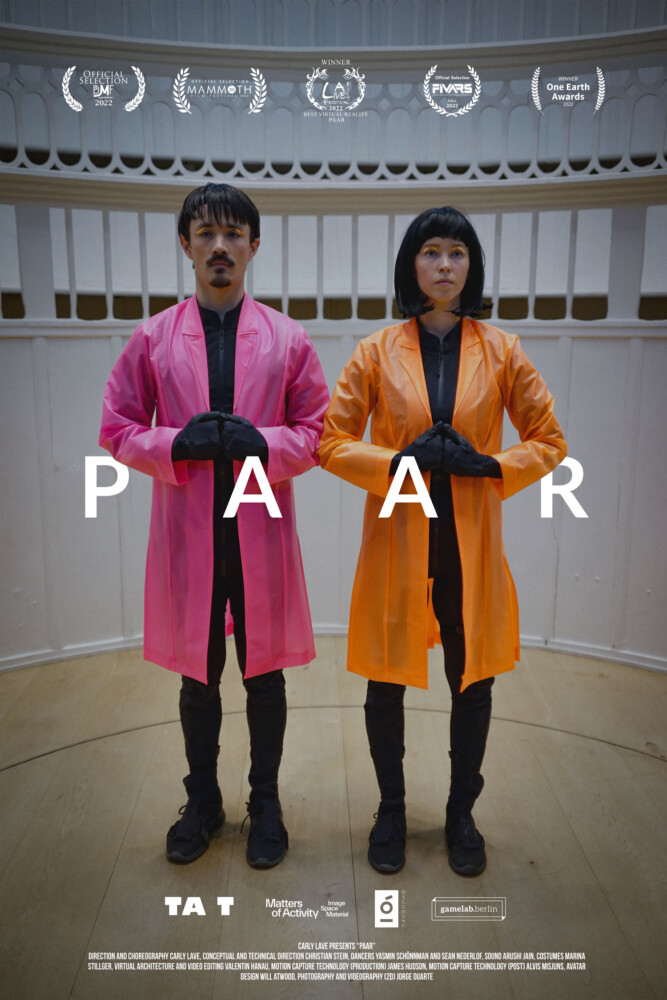
film festivals & awards
Paar has been accepted into numerous Film Festivals
and won awards internationally including:
New Media Festival | Official Selection | June 2023
Poppy Jaspar International Film Festival | Official Selection | April 2023
Mammoth Film Festival | Official Selection | March 2023
Diametrale Film Festival | Official Selection | March 2023
Digital Media Festival Rome | Official Selection | December 2022
Film Fest LA | Best work in Virtual Reality | Official Selection | November 2022
Urban Media Makers Film Festival Atlanta | Official Selection | October 2022
FIVARS Film Festival Toronto | Official Selection | October 2022
One Earth Awards India | Best work in Virtual Reality | September 2022
Project Info
Paar
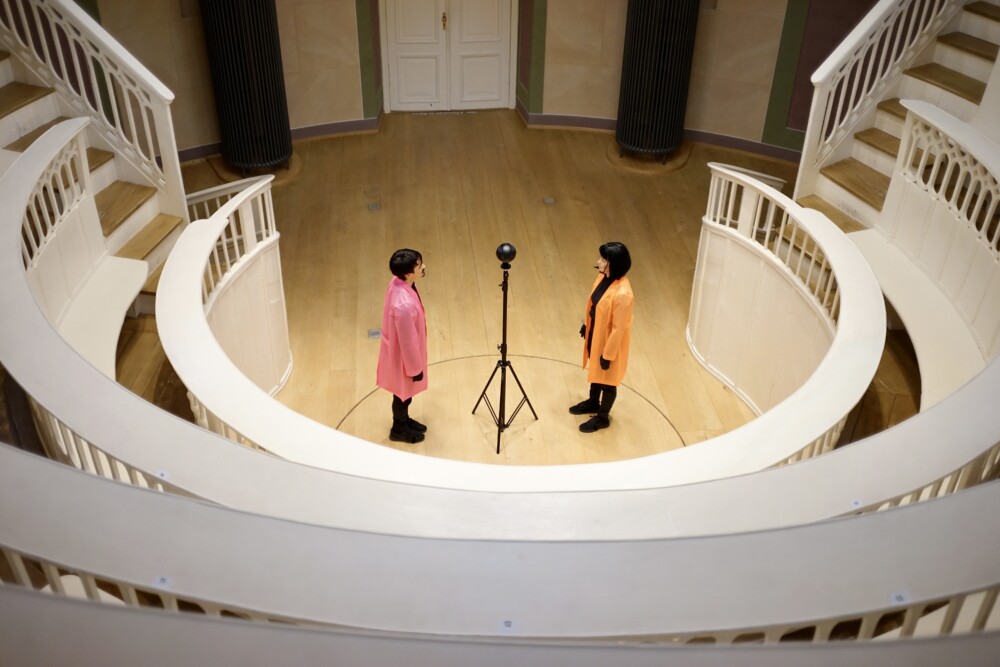
Paar is a VR dance film split between a physical and virtual world. Filmed in the historic GDR-era Tieranatomisches Theater (TAT) at Berlin Charité hospital, Paar uses 360 video together with motion capture technology to follow a journey of discovery between linked bodies and theaters.
Drawing on the eerie past of the site’s animal anatomical research, two ghostly beings dance across parallel spaces, whilst discovering their human bodies and physical environment. Their movement journey imparts an energetic transmission of intimacy, curiosity and possibility via choreographic forces of glitch and fluidity. The dancers discover the tactile nature of their flesh and architectural surroundings for the first time. In Paar, dance becomes a language through which the story is told, and the scenography shifts and materializes into expansive imaginings.
In Paar, the audience stands center within the VR experience. Choreography, sound and light pull the audience to rotate in place, widening the visual periphery in 3D. The audience is invited to join the dancers in their discovery of the liminal space between virtual and physical worlds. The immersive experience reveals a transformation of past to present;avatar to human; material to immaterial existence.
The choreography and direction is devised by dance artist Carly Lave with support by Dr. Christian Stein, cofounder of gamelab.berlin, and set to an ambient sonic landscape by the artist Arushi Jain founder of label Ghunghru Sounds.

Paar integrated multiple technological components to drive the composition of video across physical and virtual space.
- 360 Video
- Photogrammetry
- Sound Spatialization
- Motion Capture Technology
Our team used the Insta360 Pro camera together with the Rokoko motion capture suit to record sequences of choreography alongside live 360 footage. We integrated this real-world footage with a virtual model of the theater that was specially designed for the performance. Paar was shot as a 6K stereoscopic recording.
The virtual model is developed from a 3D photorealistic rendering, created via a process of photogrammetry shot by drone technology and DSLRs. We composited these images in Unreal Engine to create a hyper-realistic model to splice with our live film, making for 180° of virtual world and 180° of physical world viewable in VR.
The sound is further spatialized to the theater’s environment and choreography. As the audience rotates through the experience, layers of sound pan and occupy 3D space in the virtual world. I worked closely together with collaborator Arushi Jain to spatialize the score in alignment with choreographic choice and transition.
In Paar, the dancers’ movement is tracked via motion capture technology. The movement data is placed on avatars dancing through the virtual space. This recorded movement data will be mapped into the virtual environment of the TAT and edited together during post-production.
In Paar, the dancers’ movement is tracked via the Rokoko motion capture suits and technology. The movement data was rendered and cleaned within Blender, and later rigged to our bespoke avatars mapped onto the virtual environment of the TAT and again edited together in Unreal during post-production.
In developing the choreography, I sought to play with the circularity of the Tieranatomisches Theater Berlin, using spirals and revolutions around the space, and within the dancers’ own bodies. The movement was inspired by patterns revolving around the room, creating a narrative throughline splicing the physical theater and virtual rendering of the theater. Furthermore, the ancestral past of the site inspired ritual quality in movement aesthetic and avatar caricature. The avatars’ appearance harken to the animal bodies, and carcasses, that moved through the venue’s past decades before.
The choreography plays with the circularity of the theater, using spirals and revolutions around the space, and within the dancers’ own bodies. The movement was inspired by patterns revolving around the room, creating a narrative throughline splicing the physical theater and virtual rendering of the TAT.
Together the project integrates cutting-edge technology to devise a new format to experience performance across physical and virtual spaces of the Tieranatomisches Theater.
Creative Team
Choreography + Direction:
Carly Lave
Cinematography:
Dr. Christian Stein
Dancers:
Sean Nederlof, Yasmin Schönnman
Costumes:
Marina Stillger
Sound:
Zid by Arushi Jain
Technical Team
Motion Capture Technology (Production):
James Hudon
Virtual Architecture and Video Editor:
Valentin Hanau
Motion Capture Technology (Post-Production):
Alvis Misjuns
Avatar Design:
Will Atwood
Photography + Videography (2D):
Jorge Duarte
Premiere:
June 9 2022, Paar at the TAT
Location:
Tieranatomisches Theater, Charité Berlin, Berlin, Germany
Support from:
Tieranatomisches Theater Humboldt-Universität zu Berlin, gamelab.berlin, GHUNGHRU Sounds and Matters of Activity Humboldt-Universität zu Berlin
Team and Bios:
Christian Stein
Dr. Christian Stein studied German language and literature and computer science, earned a doctorate in literary studies and has since been working in the border area between the humanities and technical sciences. He is employed at the Cluster of Excellence Matters of Activity and heads the Object Space Agency project. In the Cluster of Excellence Image Knowledge Design, which was completed in 2019, he served as head of the research area Architectures of Knowledge with six research projects and is co-founder of gamelab.berlin, which deals with play as a cultural technique. In this context he has focused on the development of game prototypes in the field of museums and medicine. This includes the development of innovative museum games (e.g. game+ultra and Mein Objekt in Humboldt Forum ) and VR applications (e.g. Neurosurgery 360 and Kenya VR). In addition to his focus on games, he works on artificial and natural languages (semantic web and modeling) as well as an interdisciplinary theory of the interface, on which he is currently completing his habilitation project.
Sean Nederlof
Coming from a background of street dance and martial arts, Sean Nederlof studied Ballet, Contemporary and Modern dance at the University of California, Santa Barbara and earned a BFA in Dance. For five years he worked in New York City as a contracted dancer with HT Chen & Dancers and Abarukas and freelanced for companies such as Pilobolus and J Chen Project. In 2018 he was the Audience Choice for Best Solo Performance at the Masdanza International Festival for Contemporary Dance. Since moving to Berlin, Sean primarily dances with Sasha Waltz & Guests and he collaborates with other choreographers such as Juliette Rahon, Ruben Reniers and Yasmin Schönmann.
Yasmin Schönmann
Yasmin Schönmann is a dancer, choreographer and digital artist from Germany with a Diploma in Contemporary Dance from Iwanson International Munich and an MFA in Dance and Technology from New York University.
She is an artist who is interested in the human experience; The work she creates evolves around our emotional world, human connection and political and social issues. Her artistic research is based on physical but human gestures and movement, as well as a clear story line. In her dancing the body becomes a powerful instrument to communicate and express emotions. As a dancer she has worked for and collaborated with artists such as Juliette Rahon & Co, Maxim Didenko/Vladimir Varnava, Laura Scozzi, Yu Otagawi, Hagar Ophir/Yael Bartana, Carly Lave, Aaron S. Davis, the Alma Mahler Kammerorchester and many more.
Yasmin has received several recognition for her artistic work, including the GVL Scholarship (2021), DisTanzen Solo Scholarship (2021), Pandemic Healing Arts Grant (2020), Shubert Foundation Scholarship (2018), Danspace Residency (2017), and Open Studios for promising young choreographers from Tanztendenz (2014). Her work has been presented at numerous venues in New York, the InHale Series in Philadelphia, at Féstival Chorégrafique Blois, Holzmarkt Berlin, and at iCamp, Kranhalle and Einstein Kultur in Munich.
Marina Stillger
Marina Stillger studied Fashion Design at the University of Buenos Aires in Argentina, moving to Europe 4 years ago to work in theater, fashion and costume design. After her first internship/hospitanz at MAXIM GORKI THEATER, she discovered a new face in fashion, and since then has been working with theater and video projects at large. Recently, she made costumes for “Die böse Frau” for Tobias Winter, and for “Dancing Matters” a VR dance video for Humboldt Universität zu Berlin and Charité Berlin in the frame of the festival and exhibition “Stretching Materializes” which is exhibited at the Tieranatomisches Theater at Charité Berlin. She also has her own project which combines design, upcycling and sustainability, giving a second life to clothes found on the streets of Berlin with the hope to find a more sustainable approach to fashion.
Arushi Jain
OSE | ओस is the moniker of Arushi Jain, a San Francisco based pioneering sound architect and modular synthesist. She brings out the vibrancy of hindustani classical music in modern electronic movements, by composing electronic music heavily inspired by her background as an Indian classical musician. She grew up in Delhi, studying indian classical at the Prayag Hindustani Music School and the Ravi Shankar Institute in Delhi. She completed her B.S. in Computer Science from Stanford University, where she was introduced to computer generated sounds and synthesis at the Centre for Computer Research in Music and Acoustics (CCRMA). Arushi is interested in instrument design philosophies and experimentation with a focus on linking western and eastern musicology, as well as the sonic fingerprint of online platforms. Arushi is the founder of GHUNGHRU ( www.ghunghru.fm ), a radio series and record label based out of San Francisco. Arushi’s work has been reviewed on Bandcamp, Fact Magazine, XLR8R, Magnetic Magazine, Vogue and more.
James Hudson
James Hudson has a Bachelor in Computer Science, and a deep professional background in commercial software and hardware development and media arts. This includes research at the Australian Centre for Field Robotics, founding his own games company, Nocturnal Entertainment, developing software for large and small companies such as Nokia and Novartis, and also collaborating with media artists Kate Richards, Mari Velonaki, Martine Neddam (aka Mouchette), and Anne Roquigny. He has over 30 apps in the Google Play and Apple App Stores. His personal apps have been in the top 5 downloads in 6 countries. His artistic works have been exhibited in galleries such as: Platoon Kunsthalle, MAC Creteil, Ars Electronica Linz, and Le Manège Maubeuge. He has worked as a freelance developer in Berlin for 10 years. In this time he has developed his own multimedia works based on wearable LED touch screens. This work was accepted into the Deutsche Telekom Fashion Fusion programme, and has performed at many Berlin festivals and theatres. James has also used the performance system solo, and in collaboration with artists such as Lulu Schmidt, at events such as Vienna Viennale and Vienna Popfest.
Will Atwood
Will Atwood, AKA Legible, is a multidisciplinary artist and designer. His art practice spans traditional analog media and emerging digital technologies like virtual reality sculpting, drone show design, computerized fabrication methods, etc. Through combining old and new media, Will leverages the strengths and interactions of the two to unlock unexplored creative possibilities.
Whether realized in pixel, pigment, polymer, or a plethora of other media, the work shares a common visual language. Light and line guide the eye through dynamic compositions of form, tension, torsion, and motion. Shadow and haze make areas of light appear all the more radiant, as negative space emphasizes foci of intricate detail.
Often obscured under nested layers of abstraction and complexity, themes in his work include mathematical and logical paradoxes, conscious experience, simulation, identity, recursion, and more.